Dakshana Question Paper 2018: A Complete Guide for Aspirants
If you’ve stumbled onto this page, chances are you’re either a student trying to crack the Dakshana Scholarship Selection Test, a parent trying to understand what your kid is preparing for, or a teacher looking for reference material. Either way, the “Dakshana Question Paper 2018” comes up a lot in searches, and for good reason — it’s one of the older, well-circulated papers that students still practice with today, even years later. Old papers have a funny way of sticking around in the coaching world.
This guide walks through what the Dakshana test actually looks like, how the 2018 paper fits into that pattern, how many questions you can expect, the marking scheme, how to actually build a study schedule around it, and why going through previous papers (not just this one) genuinely helps.
What Is the Dakshana Foundation, Really?
Before jumping into the paper itself, a quick bit of context helps. The Dakshana Foundation was started back in 2007 by Mohnish Pabrai, an Indian-American investor who wanted to do something meaningful for bright students who simply don’t have the money for JEE or NEET coaching. The idea is straightforward: find talented kids from low-income, mostly rural backgrounds, and give them free, intensive coaching so they can compete on a level playing field with students who’ve had access to expensive coaching institutes since Class 9.
To get into the program, students have to clear an entrance exam. Depending on the intake, this is either the JDST (Joint Dakshana Selection/Scholarship Test), which is an online exam mainly for Class 12 science students, or the NDST (Navodaya Dakshana Selection Test), an offline version for students from Jawahar Navodaya Vidyalayas and EMRS schools. There are also separate income and academic eligibility criteria — generally, family income needs to be under a certain threshold and students need strong marks in their Class 10 boards.
The “2018 question paper” specifically refers to one of these selection tests conducted that year, and it’s become something of a benchmark paper that later batches use for practice, mostly because it’s easy to find and reasonably representative of the pattern the foundation has followed for years.
Exam Pattern and Total Number of Questions
Here’s where a lot of students get confused, so let’s lay it out plainly. The Dakshana selection test, in the years around 2018 and largely still today, follows this structure:
- Total questions: 100 multiple-choice questions
- Sections: 4 sections, each with 25 questions
- Logical Reasoning
- Mathematics (for engineering-track students) or Biology (for medical-track students)
- Physics
- Chemistry
- Duration: 3 hours
- Question type: Objective, multiple choice, single correct answer
- Syllabus base: Mostly NCERT Class 9 and Class 10 topics, though the logical reasoning section draws from general aptitude rather than a textbook syllabus
One thing worth noting — and this trips a lot of people up — is that even though the exam is meant to select students who will go on to prepare for JEE and NEET (which are Class 11-12 level exams), the actual test itself is pegged closer to Class 9-10 level content. That’s intentional. The foundation is testing raw aptitude and grasp of fundamentals, not advanced coaching-level tricks. So don’t panic if you see questions that feel “too basic” compared to what your coaching material has you doing — that’s the point.
The Marking Scheme
The Dakshana test uses negative marking, which is honestly one of the more important things to internalize early. For every wrong answer, one mark gets deducted. This means blind guessing across the board can actually hurt your score more than it helps, unlike some exams where guessing is a low-risk move. Students who go in without knowing this sometimes attempt every single question just to “fill the sheet,” and end up doing worse than if they’d left uncertain ones blank.
A rough (and I mean rough, because exact weightage can shift slightly year to year) way to think about it: each correct answer earns you a mark, each wrong one costs you a mark, and unattempted questions are simply zero. So the smarter strategy is usually to attempt everything you’re fairly confident about, skip pure guesses, and come back to borderline questions only if time allows.
How to Study for the Dakshana Paper
Now for the part everyone actually wants — how do you prepare for this thing?
1. Get your NCERT basics rock solid. Since the test leans heavily on Class 9-10 NCERT content for Maths, Physics, and Chemistry, this isn’t the place to be reading advanced reference books. Go back to your NCERT textbooks, work through every solved example, and don’t skip the “extra” exercises at the end of chapters that most students ignore.
2. Don’t neglect logical reasoning. A lot of students pour all their energy into Maths/Science and treat the reasoning section as an afterthought. That’s a mistake. It’s a full 25 questions — a quarter of your total score — and it’s actually one of the easier sections to improve quickly with regular practice, since it’s more about pattern recognition than memorized content.
3. Practice under timed conditions. Three hours for 100 questions sounds like a lot until you’re actually in the exam and realize you’ve spent 40 minutes on the reasoning section alone. Time yourself from the start, not just in the final week.
4. Use previous papers, including the 2018 one, as diagnostic tools, not just practice. More on this below.
5. Review your mistakes, not just your scores. After every mock or past paper attempt, go through every wrong answer and figure out why it was wrong — careless error, conceptual gap, or a trick in the wording. Students who just note their score and move on tend to repeat the exact same errors.
Building a Preparation Schedule
A schedule only works if it’s realistic, so here’s a simple 6-week structure you can adapt:
- Weeks 1-2: Revise the NCERT Class 9 syllabus fully — Maths, Physics, Chemistry (or Biology). Do a handful of logical reasoning questions daily just to get familiar with question types.
- Weeks 3-4: Move to Class 10 syllabus. Start attempting sectional practice tests — one section at a time, timed.
- Week 5: Take full-length mock tests, including the 2018 paper and any other previous papers you can get your hands on. Simulate real exam conditions: same time of day, no phone, strict 3-hour limit.
- Week 6: Focus entirely on revision and weak areas identified from your mocks. Avoid learning brand-new topics this late — it usually does more harm than good to confidence.
Adjust the timeline based on how much runway you actually have before your test date, but keep the general order: build fundamentals first, then test yourself, then patch the gaps.
Why Previous Papers Dakshana Question Paper 2018 Actually Matter
It’s tempting to think of past papers as just “extra practice,” but they do something more specific than generic practice sets:
- They show you the actual difficulty level the foundation tests at, which can be quite different from what your coaching material assumes.
- They reveal recurring question patterns, especially in logical reasoning, where certain question types show up year after year.
- They help you get comfortable with the exact format — 100 questions, 4 sections, negative marking — so none of it feels unfamiliar on exam day.
- They’re a genuinely good way to benchmark your speed, since generic practice sets aren’t always calibrated to the real exam’s difficulty and pacing.
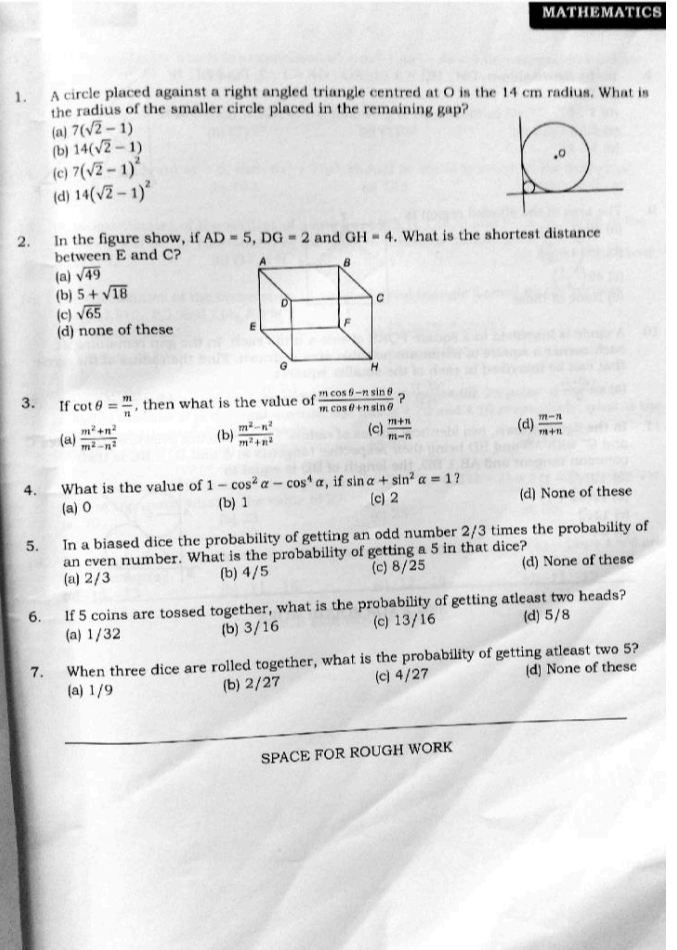
The 2018 paper specifically is popular simply because it’s widely shared and well-documented, not because it’s fundamentally different from other years. If you can get your hands on multiple years’ papers, use all of them — more data points give you a much better sense of the pattern than relying on just one year.
A Few Common Mistakes Students Make
Worth calling out directly, since these come up again and again:
- Ignoring the reasoning section until the last week
- Not practicing with negative marking in mind, so real exam performance drops compared to practice scores
- Over-relying on advanced JEE-level material instead of nailing NCERT basics
- Skipping timed practice and only doing “casual” question-solving
- Not reviewing wrong answers carefully enough to actually learn from them
None of these are fatal, but catching them early saves a lot of frustration later.
Final Thoughts
The Dakshana Question Paper 2018 isn’t magic — it’s just one solid, well-circulated snapshot of a consistent exam pattern that the foundation has used for years. Treat it as a diagnostic tool early in your prep, and as a full-dress rehearsal closer to your actual test date. Combine it with strong NCERT fundamentals, consistent reasoning practice, and honest review of your mistakes, and you’ll walk into the real exam with a genuinely good sense of what to expect.