GDS to MTS Question Paper: A Complete Guide for Departmental Exam Aspirants
Introduction
If you’re a Gramin Dak Sevak (GDS) working under India Post and dreaming of a regular government post, the GDS to MTS question paper is probably the thing standing between you and that Multi Tasking Staff (MTS) designation. And honestly, it’s not some far-off dream — thousands of GDS employees clear this departmental exam every year and move into MTS roles. But like with most government exams, the difference between clearing it and not usually comes down to one thing: how well you understand the actual question paper, not just the syllabus on paper.
This exam is technically called a Limited Departmental Competitive Examination (LDCE), and it’s conducted by India Post, circle-wise, to fill MTS vacancies from within the GDS cadre. So it’s not open to outsiders — only serving GDS employees who meet the eligibility norms set in the official notification can sit for it. In this article, we’ll walk through the exam details, pattern, how questions are structured, what the syllabus actually covers, and why going through old question papers is honestly one of the smartest things you can do before exam day.
Exam Details
Let’s get the basics out of the way first. The GDS to MTS exam is conducted by India Post at the circle level: each postal circle (such as Maharashtra, Uttar Pradesh, Karnataka, etc.) releases its own notification and conducts the exam separately, though the overall structure remains roughly the same across circles.
A few things worth knowing:
- Who can apply: Gramin Dak Sevaks who fulfill the minimum service tenure, age, and educational qualification criteria mentioned in the respective circle’s official notification.
- Exam type: Objective, multiple-choice based, offline (pen and paper, OMR sheet).
- Conducted by: India Post, circle-wise, as part of the LDCE process.
- Purpose: To promote/regularize eligible GDS staff into the MTS cadre, and in some circles this same exam framework also feeds into Postman and Mail Guard promotions (though those posts usually involve additional papers).
- Language of paper: Generally available in English and Hindi, sometimes the regional language too, depending on the circle.
One thing that trips people up — MTS aspirants generally only need to worry about Paper I. Postman and Mail Guard candidates going through the same recruitment cycle often have extra papers (like a local language paper), but if MTS is your target, Paper I is really where your focus should be. That said, some circles do require clearing a qualifying local-language paper alongside it, so it’s worth double-checking your own circle’s notification rather than assuming.
Exam Pattern
Now here’s where it gets useful. Based on how India Post circles have structured this exam in recent cycles, the GDS to MTS Paper I generally looks like this:
- Total Questions: 50
- Total Marks: 100 (2 marks per question)
- Duration: 60 minutes
- Question Type: Multiple choice
That works out to a little over a minute per question, so speed and accuracy both matter here — you can’t afford to sit and overthink every single question.
The paper is typically split into two broad parts:
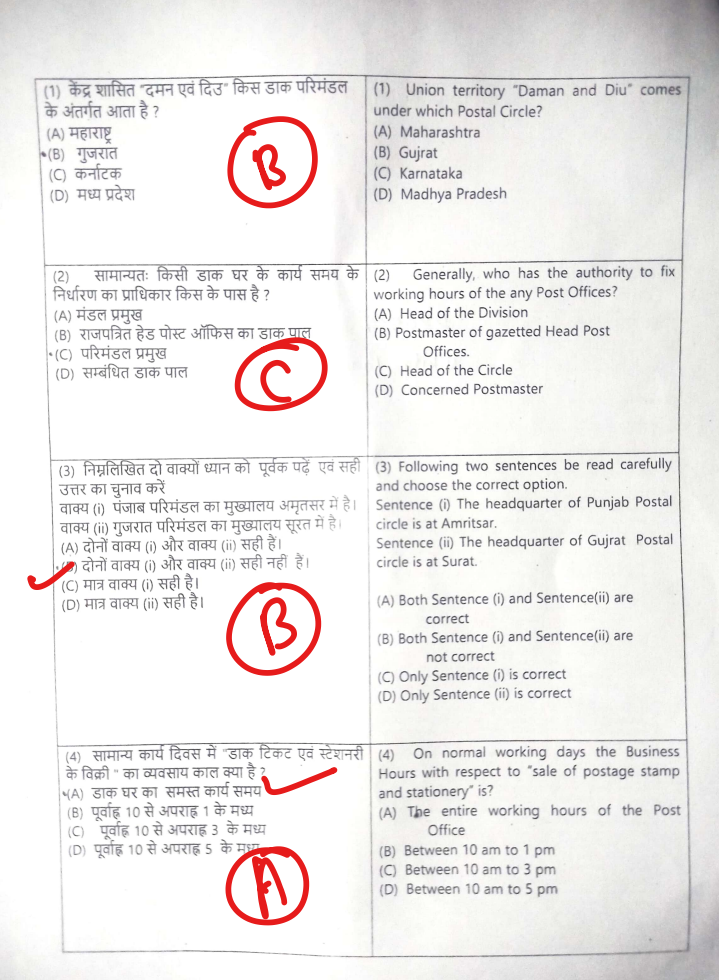
Part A – Postal Knowledge (30 questions, 60 marks). This is drawn mainly from two official sources — the Post Office Guide Part I and Postal Manual Volume V. This part alone usually carries the most weight in the entire paper, so if there’s one section to really nail down, it’s this one.
Part B – General Awareness & Arithmetic (20 questions, 40 marks). This is usually split roughly evenly — around 10 questions from General Knowledge/current affairs, and 10 from basic arithmetic (percentages, BODMAS, simple interest, ratios, and similar topics you’d have studied at a middle-school level).
Do keep an eye on your circle’s official notification for negative marking rules, since this can vary — some cycles have applied it, others haven’t. Don’t assume either way; verify it directly.
Numbering Pattern
Since this is an objective, OMR-based paper rather than a descriptive one, the numbering pattern is fairly straightforward, but there are a few conventions worth knowing before you sit for it:
- Questions run sequentially from Q1 to Q50 — there’s no separate sectional restart, even though the content is logically divided into Part A and Part B.
- Each question usually has four answer options (A, B, C, D), and you mark your response by darkening the correct bubble on the OMR sheet.
- Questions from Part A (Postal Knowledge) typically appear first, followed by General Awareness questions, and then Arithmetic questions at the end — though this order can shift slightly between circles.
- Every question carries equal weightage of 2 marks, so there’s no “big question, small question” imbalance as you’d see in a descriptive exam. This actually works in your favor — an easy GK question is worth exactly as much as a tricky arithmetic one.
- The OMR sheet itself usually carries a roll number and question-paper-set code (like Set A, B, C, D) that you need to fill in carefully — a mismatched set code has cost candidates marks before, so don’t rush this part.
| Circle Name | GDS to MTS/Postman Exam Question Paper | Answer Key |
|---|---|---|
| Andhra Pradesh | PDF DOWNLOAD | PDF DOWNLOAD |
| Assam | PDF DOWNLOAD | PDF DOWNLOAD |
| Bihar | PDF DOWNLOAD | PDF DOWNLOAD |
| Chattisgarh | PDF DOWNLOAD | PDF DOWNLOAD |
| Delhi | PDF DOWNLOAD | PDF DOWNLOAD |
| Gujarat | PDF DOWNLOAD | PDF DOWNLOAD |
| Haryana | PDF DOWNLOAD | PDF DOWNLOAD |
| Himachal Pradesh | PDF DOWNLOAD | PDF DOWNLOAD |
| Jharkhand | PDF DOWNLOAD | PDF DOWNLOAD |
| Jammu & Kashmir | PDF DOWNLOAD | PDF DOWNLOAD |
| Karnataka | PDF DOWNLOAD | PDF DOWNLOAD |
| Kerala | PDF DOWNLOAD | PDF DOWNLOAD |
| Madhya Pradesh | PDF DOWNLOAD | PDF DOWNLOAD |
| Maharashtra | PDF DOWNLOAD | PDF DOWNLOAD |
| North East | PDF DOWNLOAD | PDF DOWNLOAD |
| Odisa | PDF DOWNLOAD | PDF DOWNLOAD |
| Punjab | PDF DOWNLOAD | PDF DOWNLOAD |
| Rajasthan | PDF DOWNLOAD | PDF DOWNLOAD |
| Tamilnadu | PDF DOWNLOAD | PDF DOWNLOAD |
| Telangana | PDF DOWNLOAD | PDF DOWNLOAD |
| Uttarkhand | PDF DOWNLOAD | PDF DOWNLOAD |
| Uttar Pradesh | PDF DOWNLOAD | PDF DOWNLOAD |
| West Bengal | PDF DOWNLOAD | PDF DOWNLOAD |
Syllabus
The syllabus for the GDS to MTS exam is honestly not too vast, which is good news if you’re preparing while still working full-time as a GDS. Here’s roughly how it breaks down:
Post Office Guide Part I covers:
- Organization of the postal department
- Types of post offices
- Business hours
- Payment of postage, stamps, and stationery
- General rules on packing, sealing, and posting articles
- Methods of address
- Post boxes and post bags
- Duties of a Letter Box Peon
- Official and prohibited postal articles
- Products and services offered — Mail, Banking & Remittances, Insurance, and Stamps/Business
Postal Manual Volume V covers departmental rules and procedures relevant to day-to-day postal operations — this section is smaller in question count but still important since a chunk of Part A questions come directly from here.
General Awareness is fairly open-ended — expect questions on current affairs, government schemes, basic history/geography, and sometimes postal-specific general knowledge.
Arithmetic stays at a basic level — BODMAS, percentages, profit and loss, simple interest, ratio and proportion, averages — nothing beyond what’s typically covered up to middle school math.
Why Previous Question Papers Matter
Here’s the truth: reading the syllabus alone won’t tell you how questions are actually framed. That’s exactly why previous GDS to MTS question papers are so valuable.
- They show you the real difficulty level. Official syllabus documents don’t tell you whether a topic gets asked as a simple one-liner or a slightly twisted question. Old papers do.
- They help you manage the 60-minute crunch. Practicing with real timed papers is the only real way to know if you can finish all 50 questions comfortably.
- They highlight repeat topics. Certain areas — like duties of a Letter Box Peon, or specific postal definitions — tend to show up again and again across cycles.
- They reduce exam-day nerves. Walking into the exam hall having already solved several papers in the same format makes a real psychological difference.
- They’re great for self-assessment. Solving a paper and checking your score honestly tells you where you actually stand, rather than just how confident you feel.
If you’re serious about clearing this exam, treat old papers as a core part of your prep — not an afterthought you get to “if there’s time.”
Final Words
The GDS to MTS question paper isn’t an exam you need to fear — it’s actually one of the more achievable departmental promotions in India Post, provided you prepare with the right materials and don’t skip past-paper practice. Stick to the official syllabus, focus heavily on Post Office Guide Part I since it carries the most weight, keep your arithmetic basics sharp, and make previous year papers a regular part of your routine rather than a last-minute cram. Preparation for this exam fits reasonably well around a working schedule too, so consistency — even 30-45 minutes a day — will get you further than last-minute panic study ever will. Good luck with your preparation.
No. It’s a departmental exam meant only for existing GDS employees who meet the eligibility criteria in the official notification.
Generally, 50 questions, worth 100 marks total, to be completed in 60 minutes.
Usually not — MTS candidates typically only need Paper I, though some circles may require an additional qualifying paper, so it’s best to check your specific circle’s notification.
Post Office Guide Part I and Postal Manual Volume V are the two core references, along with general current affairs material and basic arithmetic practice.
This varies by circle and exam cycle, so always confirm from the current official notification rather than assuming.
Many postal exam preparation websites and study groups compile past papers, and it’s worth checking India Post’s official circulars as well, since they occasionally reference past cutoffs and patterns.